Todays technology is tomorrows technical debt – building your tech radar

or Technical Debt and the Tech Radar: Staying Ahead of Obsolescence

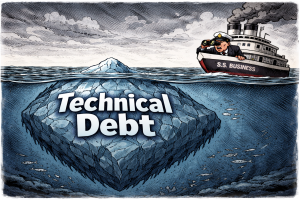
Ward Cunningham originally coined the term “technical debt” in 1992 to describe the nature of software development—specifically, the need to constantly refactor and improve inefficiencies in your code. Constant improvement. However, the technology itself becomes technical debt over time.

Consider the shift from handmade items to automation. Once automation arrived, the manual process became technical debt. As things become more efficient, older technology that once did its job adequately falls behind to newer machines and methods.

The Mainframe Example

Take servers and mainframes. In the 1940s and ’50s, computers like ENIAC filled entire rooms. ENIAC weighed over 30 tons, occupied 1,800 square feet, and consumed 150 kilowatts of power. It required elaborate cooling systems and teams of engineers to maintain. The project cost approximately $487,000—equivalent to about $7 million today.

Now consider the iPhone I’m writing this article on. According to ZME Science, an iPhone has over 100,000 times the processing power of the Apollo Guidance Computer that landed humans on the moon. Adobe’s research shows that a modern iPhone can perform about 5,000 times more calculations than the CRAY-2 supercomputer from 1985—a machine that weighed 5,500 pounds and cost millions of dollars. My iPhone uses a fraction of the power, fits in my pocket, doesn’t need a maintenance team, and cost me around $500.

Those room-sized mainframes became technical debt. Not because they stopped working, but because something dramatically better came along. So how do you prepare for the technical trends that signal what’s next to become obsolete?

What Is Technology, Really?

Before we can talk about technical debt in depth, we need to define what technology actually is.

Many people think technology means devices, microchips, or other tangible things. But in reality, technology is simply a process or an idea—a better way of doing something.

Here’s a simple example: if it takes you 15 minutes to drive to work every day, but you find a shortcut that cuts 5 to 10 minutes off your commute, that shortcut is a technology. You’ve found a more efficient process. Hardware and software are just the codification of these processes, whether it’s a chip that handles digital signal processing or a more efficient route for walking your dog.

The Triangle of Value
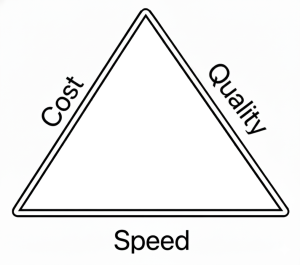
The nature of technology connects to what project managers call the Project Management Triangle (also known as the Iron Triangle or Triple Constraint). This concept, attributed to Dr. Martin Barnes in the 1960s, states: you can have three things, but you can only optimize for two at a time.

Those three things are:

  • Cost — How many resources does it take?
  • Quality — How good is the output?
  • Speed — How fast can you produce it?

Every new technology addresses one or more of these factors. Does it produce better quality? Does it make widgets faster? Does it cost less or require fewer resources?

Once you understand this perspective, technical debt becomes clearer. Technical debt is anything that negatively affects one or more parts of the Triangle of Value compared to available alternatives. Your current solution might still work, but if something else delivers better cost, quality, or speed, you’re carrying debt.

I’m Not an Inventor—So What Do I Do?

It’s true that necessity is the mother of invention. But we don’t know what we don’t know. We don’t always have the right mindset or background to invent a solution to a given problem.

However, others have encountered the same problems and asked the same questions. Some of them are inventors. They do come up with solutions, and they release those solutions into the marketplace.

The question becomes: how do I find these solutions? How do I discover the people who’ve solved the problems I’m facing?

This is where a tech radar becomes invaluable.

What Is a Tech Radar?

A tech radar is a framework for tracking upcoming technical trends that affect your industry. The concept was created by ThoughtWorks, a software consultancy that has published their Technology Radar twice a year since 2010. According to ThoughtWorks’ history, Darren Smith came up with the original radar metaphor, and the framework uses four rings—Adopt, Trial, Assess, and Hold—to categorize technologies by their readiness for use.

But the concept isn’t restricted to IT or computer science—it applies to any field. If you work in manufacturing, aluminum casting, or forging, there are emerging technologies that could make your processes more efficient. If you work in healthcare, education, logistics, or finance, the same principle applies. Some trends, like AI and the internet before it, have broad impact and touch nearly every industry because the common denominator across all fields is the manipulation of data.

The tech radar is a way to systematically track what’s emerging, what’s maturing, and what’s fading—so you can invest your time and resources accordingly.

Building Your Own Tech Radar

There’s a layered approach to building a tech radar, as described in Neal Ford’s article “Build Your Own Technology Radar.” You can enhance this process with AI tools. Here’s how to structure it:

Step 1: Identify Your Information Sources

Start by figuring out the leading sources of information for your industry:

  • Trade journals and publications — What do experts in your field read?
  • Newsletters — Many thought leaders and organizations publish regular updates
  • Websites and blogs — Company engineering blogs, industry news sites
  • Professional organizations and membershipsIEEE, ACM, industry-specific groups
  • Conferences — Both the presentations and the hallway conversations
  • Books — Especially those that synthesize emerging trends
  • Podcasts and video channels — Increasingly where practitioners share insights

Step 2: Create a Reading and Research List

Organize your sources into a structured reading list. Here’s a sample format:

Source Type Name Frequency Focus Area Priority
Newsletter Stratechery Weekly Tech business strategy High
Journal MIT Technology Review Monthly Emerging tech High
Blog Company engineering blogs Ongoing Implementation patterns Medium
Podcast Industry-specific show Weekly Practitioner insights Medium
Conference Annual industry conference Yearly Broad trends High
Book Recommended titles Quarterly Deep dives Low

Adjust the priority based on signal-to-noise ratio. Some sources consistently surface valuable trends; others are hit or miss.

Step 3: Structure Your Radar Spreadsheet

The classic tech radar uses four rings to categorize technologies:

  1. Hold — Proceed with caution; this technology has issues or is declining
  2. Assess — Worth exploring to understand how it might affect you
  3. Trial — Worth pursuing in a low-risk project to build experience
  4. Adopt — Proven and recommended for broad use

You can also categorize by quadrant, depending on your field. For software, ThoughtWorks uses:

  • Techniques
  • Platforms
  • Tools
  • Languages & Frameworks

For other industries, you might use:

  • Processes
  • Equipment/Hardware
  • Software/Digital Tools
  • Materials or Methods

Here’s a sample spreadsheet structure:

Technology Quadrant Ring Date Added Last Updated Notes Source
Large Language Models Tools Adopt 2023-01 2024-06 Mainstream for text tasks Multiple
Rust programming Languages Trial 2022-03 2024-01 Memory safety benefits Engineering blogs
Quantum computing Platforms Assess 2021-06 2024-03 Still early, watch progress MIT Tech Review
Legacy framework X Frameworks Hold 2020-01 2023-12 Security concerns, declining support Internal assessment

Step 4: Use AI to Aggregate and Summarize

If you’re monitoring many sources, you can build an aggregating agent that:

  • Pulls in articles from your reading list
  • Identifies recurring themes and emerging trends
  • Flags when multiple sources mention the same technology
  • Summarizes key points so you can triage quickly

Some trends come and go. Others stick around and reshape industries. The goal isn’t to chase every new thing—it’s to assess which trends deserve your attention and investment.

Step 5: Review and Update Regularly

Set a cadence for reviewing your radar:

  • Weekly — Scan your newsletters and feeds, note anything interesting
  • Monthly — Update your radar spreadsheet, move items between rings if needed
  • Quarterly — Step back and look at patterns; what’s accelerating, what’s stalling?
  • Annually — Major review; archive obsolete items, reassess your sources

The Cost of Ignoring the Radar

Here’s a cautionary tale. In the 1970s and ’80s, Digital Equipment Corporation (DEC) was a giant in the minicomputer market. Co-founded by Ken Olsen and Harlan Anderson in 1957, DEC grew to $14 billion in sales and employed an estimated 130,000 people at its peak.

But as MIT Sloan Management Review notes, DEC failed to adapt successfully when the personal computer eroded its minicomputer market. The company’s struggles helped inspire Harvard Business School professor Clayton Christensen to develop his now well-known ideas about disruptive innovation.

Olsen was forced to resign in 1992 after the company went into precipitous decline. Compaq bought DEC in 1998 for $9.6 billion, and Hewlett-Packard later acquired Compaq.

The technology DEC built wasn’t bad. It just became technical debt when something better arrived. They were married to their favorite technology and weren’t ready to change with the times.

Conclusion

Technical debt isn’t just about messy code or shortcuts in a software project. It’s about the broader reality that any technology—any process, any tool, any method—can become debt when something more efficient comes along.

The tech radar is your early warning system. Build one. Maintain it. Use it to make informed decisions about where to invest your learning and your resources.

And remember: don’t be married to your favorite technology or methodology. The next wave of technical debt might be the tool or process you’re relying on right now.


References

Concepts and Definitions

Historical References

People

Computing Power Comparisons

Professional Organizations (for Tech Radar Sources)

  • IEEE (Institute of Electrical and Electronics Engineers): ieee.org
  • ACM (Association for Computing Machinery): acm.org

Further Reading

  • Book: DEC Is Dead, Long Live DEC: The Lasting Legacy of Digital Equipment Corporation by Edgar H. Schein et al. Amazon
  • ThoughtWorks Technology Radar Hits and Misses: ThoughtWorks

Trust But Verify: Testing AI Agents

Trust, But Verify: Testing AI Agents

When Ronald Reagan said “trust, but verify,” he was referring to a Russian proverb “doveryai, no proveryai,” which he learned from his adviser Suzanne Massie and used during nuclear arms control negotiations with the former Soviet Union. In the same way, these powerful AI agents are useful but we need to test them. As much as we trust them, we need to verify them as much as we test and verify our code with unit and end to end testing.

AI agents are non-deterministic so you can’t do the standard ASSERT and get an expected response. Instead, we do an evaluation of the agent.

This is a core DevOps principle in CI/CD as well as other Agile coding frameworks, to test all your code with automated tests. That way you can have confidence in the behavior of your AI agent application.

To illustrate how this process would look, I’ve created a simple REPL chatbot which uses an LLM and acts as an expert on gardening and raising tomatoes.

Breaking Down the Agent for Testing

When you start developing tests for LLMs, you need to consider that as these tests are non-deterministic, the standard process for unit testing is to break down the program into smaller components. In the same way, you take your AI agent and break it down into smaller components that are testable.

However, what do you really test since it is non-deterministic? You cannot judge it by the answer as much as you have to judge it by whether it follows certain actions. For example, when it is told to use a tool such as a search engine MCP Server, does it actually execute the command for acquiring a tool or accessing a database and so on and so forth?
In the case of the AI Tomato Chat App, I have it evaluate the following:

  1. TestTomatoExpertiseQuality: Core quality metrics
    • test_answer_relevancy – Parametrized test with 3 tomato Q&A pairs
    • test_zero_toxicity_friendly_response – Validates encouragement responses
    • test_zero_toxicity_pest_response – Validates pest control responses
    • test_off_topic_rejection_quality – Ensures polite refusals
    • test_topic_adherence_planting – Custom metric for planting advice
    • test_topic_adherence_disease – Custom metric for disease advice
  2. TestFaithfulness: Factual accuracy verification
    • test_ph_level_accuracy – Validates pH range 6.0-6.8
    • test_spacing_accuracy – Validates plant spacing guidelines
    • test_watering_advice_accuracy – Validates watering recommendations
  3. TestChatbotIntegration: Integration tests with mock LLM and DeepEval
    • test_chatbot_produces_relevant_response – End-to-end container growing test
    • test_chatbot_refusal_is_polite – Off-topic refusal toxicity check
  4. TestExpertiseScenarios: Domain-specific scenarios
    • test_expertise_coverage – Parametrized test validating 4 scenarios (disease, pruning, climate, blossom end rot)
    • test_variety_knowledge – Validates knowledge of 9 common tomato varieties
  5. TestOffTopicResponse: Off-topic handling quality
    • test_off_topic_response_structure – Validates polite, helpful structure
    • test_off_topic_response_not_dismissive – Ensures no dismissive language

If you are able to consistently have the AI agent via the prompt execute tasks or commands, and you’re able to test this and test for consistency, then the AI agent and the prompt actually becomes code that’s reliable. It’s an actual piece of software that is testable versus something that is not.

So you test for a number of things: you test whether it uses tools, you test for whether there’s consistency in its answers, whether it is able to follow through, and you test for whether the answers are hallucinated.

AI as a Judge

The second component that you need besides breaking down the tasks and breaking down the AI into smaller parts that can be tested is to use an AI as a judge. Chip Huyen in her book AI Engineering describes this process of using an AI as a judge. She says to use the second most powerful AI to act as a judge. For example, if you’re using GPT-4 or GPT-5, use GPT-4 as an evaluator judge.

The AI in this case would generate various inputs and then establish what the criteria for the output should be. Based on that, you can grade how the AI agent performed. If you find that there is something that’s inconsistent, this is where you would update or change the prompts and make the adjustments. As I’ve said in earlier articles, use an AI to help you write the prompts—just factor into it what’s happening with the prompts.

Testing Tools and Frameworks

What type of tools do I use for this? In this example I used DeepEval for unit testing the application. DeepEval is set up to work with Python and work like pytest except it tests the AI for how it responds and how it works. The AI_TEST.md covers the evaluation of the AI using DeepEval.

There are other frameworks for testing and here are some alternatives worth exploring:

  • LangSmith – Observability and evaluation platform by the LangChain team
  • Ragas – Framework specifically built for RAG pipeline evaluation
  • MLflow – Modular package for running evaluations in your own pipelines
  • TruLens – Open-source library focused on qualitative analysis of LLM responses
  • Opik – Open-source LLM evaluation platform by Comet
  • Langfuse – Open-source LLM engineering platform for observability and evaluation

Logging and User Feedback

The other thing to consider implementing in your application is a place for user feedback. User feedback is important because that can tell you what direction things are going. You need to have traceability and you need to be able to test your application, so you add a place to log how API calls are made and how the interactions occur, including what kind of thought process was involved in the logs.

I would incorporate logging into the AI application if at all possible. But what I would be logging in particular, since it is non-deterministic and the answers will be different every time, is whether it is doing stuff like using proper tools or doing proper calls or accessing resources or following rules or guidelines in the prompts.

Prompts as Code

This also brings up another point: treat your prompts that you develop for your AI agent as code itself. In this sense, you are also unit testing the prompts as well as the overall AI application with end-to-end tests and unit tests of each individual component. This aligns with Test-Driven Development (TDD) principles where you write tests before writing code, ensuring your prompts meet defined criteria before deployment.

While you cannot expect determinism from an AI application, you can expect it to have certain consistencies. One of the things you do when you develop an agentic application is set the temperature to zero versus the temperature to one, meaning it will work without too many variations offered in its behavior.

There are other kinds of factors to use or to consider, but these are some of the basics. These basics will change over time as the LLMs and the AI technology becomes more advanced and as we make new discoveries.

I am open to feedback and welcome what you have to say. Otherwise, have a nice day.


References

Historical & Conceptual

AI Engineering & LLM Evaluation

DevOps & CI/CD

Agile & Test-Driven Development

Testing Frameworks

Retooling for AI Literacy 2026

“The illiterate of the 21st century will not be those who cannot read and write, but those who cannot learn, unlearn, and relearn.”Alvin Toffler

In this new year, you cannot ignore the paradigm shifts happening in our world, and the paradigm shift right now is AI. A couple years ago, AI was just an interesting toy. Well, that was also true about Linux—just a basement project by Linus Torvalds that became the foundation of the Internet and the open source world. AI is following a similar revolutionary path, and those who take advantage of it will profit while those who don’t will fall behind.

Even with its current limitations—it’s not fully autonomous and lacks common sense—AI can do a lot of useful stuff right now. My professional interest, and probably yours, is making useful tools. It’s good at writing shell scripts and basic code from a single prompt. I had it refactor my Ansible playbooks and found ways to improve what I had.

For bigger projects, so long as you use proper guardrails such as test-driven development, modularizing code, and working within AI’s constraints—you can leverage AI for everyday tasks.

This year I found myself taking on work I wouldn’t have dreamed of before. I stepped outside my familiar lane of JavaScript and Python to embrace frameworks better suited for scaling and efficiency, like Rust and Go. Tools like MCP (Model Context Protocol) opened doors by letting AI coding agents actually see and work with code. I’m now writing agentic systems using frameworks like LangChain and working with vector databases like Pinecone or ChromaDB—tools I had little familiarity with before.

These doors opened because large language models came onto the scene. If you’re holding out until AI is “safe and reliable,” I think you’ll miss the boat. What I’ve found while developing AI applications is that this is a deeply evolving ecosystem requiring you to understand and work with the plumbing in your area of expertise.

You can write agents that manage other agents in workflows using tools like CrewAI, where you create agents based on roles. You can leverage workflow frameworks with AI capabilities like n8n, which enable powerful automations. Better yet, these are self-hosted—so if you’re concerned about proprietary business logic being acquired by Big Tech, you can use open source large language models that are approaching frontier model performance.

It’s not too late to prepare yourself for this year and the coming years. It’s now possible to create a one-person startup once you learn orchestration, agents, and workflows. These systems can manage customer follow-up, lead generation, demonstrations, even writing, reviewing, and debugging code.

While AGI may never become a reality, you can do remarkable things with AI technology as it exists today. Those who learn to adapt will reap the rewards. Those who don’t… go extinct.

Happy New Year.


Connecting the Dots with n8n Workflow Automation

“You can’t connect the dots looking forward; you can only connect them looking backwards.” – Steve Jobs, Stanford University Commencement Address, 2005

This quote perfectly captures the challenge of workflow automation. You know the outcome you want, but building the path to get there? That’s where the real work begins.

n8n (pronounced “n-eight-n”) is an open-source visual workflow automation tool that lets you connect disparate systems, automate repetitive tasks, and eliminate the manual glue work that bogs down operations teams. With over 400 integrations and the flexibility to add custom code when needed, it bridges the gap between no-code simplicity and developer power.

Here’s a taste of what n8n workflows can handle:

  1. Email triage and alerting – Sort incoming messages, extract key data, and trigger Slack notifications based on sender, subject, or content.
  2. Scheduled reports – Pull data from APIs or databases, transform it into readable formats, and deliver it via email at a set time each day.
  3. Incident response automation – Monitor system health, detect anomalies, and automatically create tickets in Jira or ServiceNow while alerting on-call staff.
  4. User provisioning and offboarding – Sync HR systems with Active Directory, automatically create accounts, assign permissions, and revoke access when employees leave.
  5. Lead routing and CRM sync – Capture form submissions, enrich data, score leads, and push qualified prospects to the right sales rep in your CRM.

These aren’t hypothetical—they’re real pain points that ops teams deal with daily. The manual versions of these tasks are error-prone, time-consuming, and frankly mind-numbing.


Start with the End in Mind

“Begin with the end in mind.” – Stephen R. Covey, The 7 Habits of Highly Effective People

If Steve Jobs tells us we can only connect dots looking backward, Stephen Covey gives us the practical framework: start with your desired outcome and work backward to identify the tasks you need to do to get there.

Take a simple example: “I want to receive an email weather forecast every morning for three locations I visit often.”

Working backward, I need:

  • An email delivery mechanism
  • Weather data for each location
  • Location coordinates or city names
  • A scheduled trigger (specific time each morning)

Each of these becomes a node in the workflow. The visual canvas makes it easy to see how data flows from trigger to output.


Start with Docker for Easy Deployment

When I first experimented with n8n, I made the mistake of installing it directly on my machine. That quickly became a dependency management headache—Node.js version conflicts, database requirements, environment variables scattered everywhere.

Save yourself the trouble: use Docker or Docker Compose.

Docker Compose is my preference because it handles everything in a single docker-compose.yml file: the n8n application, the database (PostgreSQL or SQLite), and any additional services you might need. One command spins up the entire stack. One command tears it down. No residual dependencies polluting your system.

For those who want to dive deeper, here’s a minimal configuration to get started:

version: '3'
services:
  n8n:
    image: n8nio/n8n
    restart: unless-stopped
    ports:
      - "5678:5678"
    environment:
      - N8N_BASIC_AUTH_ACTIVE=true
      - N8N_BASIC_AUTH_USER=admin
      - N8N_BASIC_AUTH_PASSWORD=changeme
    volumes:
      - ~/.n8n:/home/node/.n8n

Run docker-compose up -d and you’re in business. The n8n editor will be available at http://localhost:5678.


Practical Application: Daily Weather Email Workflow

To illustrate the “working backwards” approach, I built a daily weather email workflow that delivers a forecast to my inbox every morning.

Using n8n’s visual workflow builder, I created a workflow that:

  1. Runs on a Schedule Trigger (6 AM daily)
  2. Calls the Pirate Weather API – a free, open-source weather API (see the API documentation for details)
  3. Retrieves forecast data for multiple locations
  4. Transforms the JSON response into readable HTML
  5. Formats temperature, conditions, and precipitation probability
  6. Sends a formatted email via SMTP
  7. Handles API failures gracefully with retries and fallback notifications

The entire workflow is visual, requires no custom coding (though you can add JavaScript if needed), and runs reliably every morning.


Where to Go from Here

This is just a taste. Once you’re comfortable with basic workflows, n8n opens doors to automating tasks you’d otherwise do manually or forget entirely.

Some ideas to explore:

  • Website uptime monitoring with Slack alerts when your site goes down
  • Automated backups of email attachments to Google Drive or Dropbox
  • Social media scheduling that pulls from a content calendar and posts across platforms
  • Database synchronization between your CRM, ERP, and marketing tools

The n8n community maintains hundreds of workflow templates you can import and customize. The official documentation is thorough, and the community forums are active when you hit a snag.

Start small. Pick one repetitive task that annoys you, build a workflow for it, and watch how much time it saves. That hands-on experience teaches the fundamentals and prepares you for more complex automations.

The dots will connect themselves—you just have to start at the end.


Resources

retrospect 2024

Retrospect 2024 – Don’t be the “smartest man in the room”

Retrospect – “a review of or meditation on past events”
A few things come to mind when I reflect on 2024 and think about the past year’s lessons.

1 – Don’t be the “smartest man in the room.”  The phrase “the smartest man in the room” came from Richard Holbrooke, from a 1975 article, meaning the most intelligent person does not guarantee being correct or wise.
Being in the technical profession, we tend to plan, plan and plan.  Look at every angle possible and do all our research all by ourselves.  Then, execute the plan.  Otherwise known as “Waterfall,“.
Whoever comes up with the plan is “the smartest man in the room.”  As implied by the article of the name, it doesn’t go very well for that man with the plan.
The smartest man becomes the bottleneck – since he has the plan, all the eyes look to him for the answers to what isn’t quite clear in the plan.
The smartest man doesn’t know the future – since he has the plan, he makes educated guesses on what the requirements may be.  He’s not Nostradamus, and the guesses are often wrong, which can cause the plan to fail.
The smartest man is under a lot of stress – when the plan starts going sideways, or even if it doesn’t, you can’t ultimately control the outcome.
2 – “Bring it to the team” – In the book “Coaching Agile Teams,” Lyssa Adkins often advises that you bring anything involved with the plan or affects the group to the team.  This is the basic concept of Agile and the Scrum Framework. This is the opposite of being “the smartest man in the room,” which is:
There is no bottleneck with a team – As the team of people is self-managing, everyone is in the loop.  They know what the tasks are, the big picture, with a high degree of trust.
The team doesn’t know the future but can adapt and change – instead of making guesses about everything up front into the future, you plan and make a short time-boxed sprint to minimize the risk of a bad assumption and get feedback from stakeholders to make sure you’re going the right direction with the projects.
The team shares in both the risks and rewards – As a group, you minimize the group and the stress, and also, as a group, you can do more collectively than individually.  Almost everything you use, such as a car, house, bread, and laptop computer, takes a team of people, materials, and time to make.
3 – Practice “personal Agile”Personal Scrum and other Agile tools can be used for yourself.  I have my own Kanban/Scrum board that I use to keep track of my own projects and tasks.  If you apply the concepts from Agile to yourself, it helps with things like overplanning, procrastination, and being “the smartest man in the room.”  Your “team” is the people in your network who can help you with your projects and fill in your knowledge.

What was an “Aha moment” was the Enterprise Technology Leadership Summit (“The DevOps Summit”) that I attended last year, which put a few of these things into perspective.  While I understood and used the tools and techniques for DevOps/SRE at work, you need Agile to get the most out of DevOps and the Agile mindset in your place of work.

Besides the Agile Manifesto, I recommend reading “Scrum, Do twice the work in half the time” by Jeff Sutherland.  It’s one of the most basic frameworks.

These are what I learned from 2024.

Looking forward to 2025 and maybe something useful you can get from this.